System Integration Services
Bridge the gap between your CRM, accounting software, and field tools. Turn disconnected programs into a seamless, automated data pipeline.
Capabilities
Systems Commonly Connected
System integrations can connect virtually every operational platform in your business, creating a unified flow of information between departments and software.
From Disconnected Software To Unified Operations
Before Integration
- • Data entered into multiple systems
- • Employees copy information manually
- • Records become inconsistent
- • Reporting requires spreadsheets
- • Updates are delayed
- • Departments operate in silos
- • Errors require cleanup
- • Visibility is limited
After Integration
- • Data synchronizes automatically
- • Records stay consistent
- • Updates happen in real time
- • Departments share information
- • Workflows trigger automatically
- • Reporting becomes centralized
- • Errors are reduced
- • Operations stay aligned
How System Integration Services Works
Analyze
Existing software, workflows, data structures, and operational dependencies are mapped to identify integration opportunities.
Connect
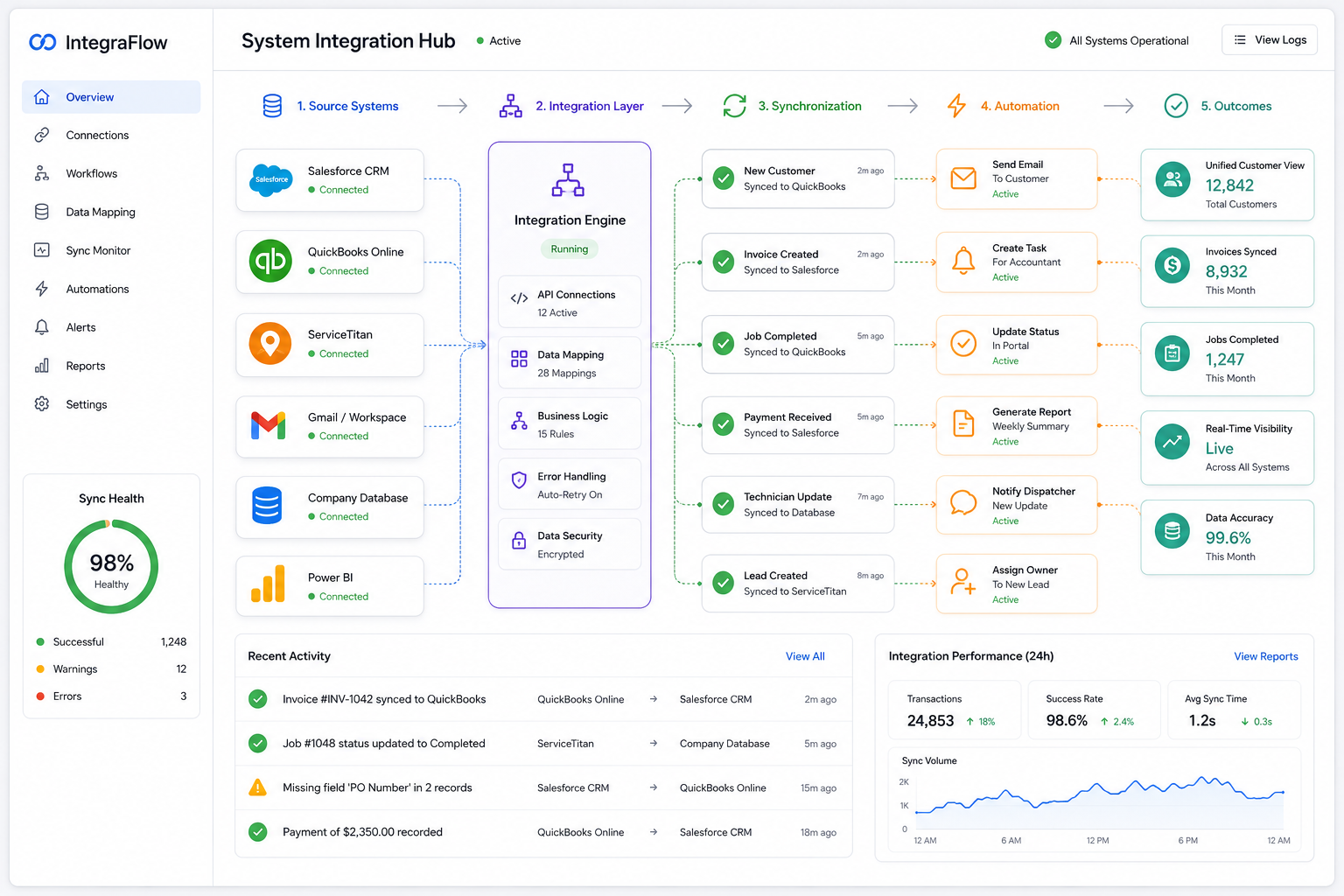
APIs, databases, webhooks, file transfers, and third-party services are connected into a unified architecture.
Synchronize
Customer records, invoices, jobs, operational data, and workflow events are synchronized automatically between systems.
Automate
Business rules trigger notifications, updates, approvals, reporting, and operational workflows across connected platforms.
Pipeline
System Integration Architecture
Visual Tour
What The System Looks Like
Connected Systems
Multiple software platforms are linked together through a centralized integration layer.
Data Synchronization
Records, updates, and workflow events move automatically between connected applications.
Unified Operations
Teams gain visibility across departments with synchronized systems and centralized reporting.
Integration Solutions
Common System Integration Projects
CRM & Accounting Integration
Synchronize customer records, invoices, payments, and job information between sales and accounting systems.
Dispatch & Field Service Integration
Connect scheduling, dispatch, technician updates, and customer communication into a unified workflow.
ERP Data Synchronization
Keep operational, financial, inventory, and customer information aligned across enterprise systems.
Lead-To-Operations Automation
Automatically move leads from marketing and sales systems into operational workflows after conversion.
Multi-System Reporting
Combine data from multiple software platforms into centralized dashboards and business intelligence tools.
Custom API Integrations
Connect specialized software, internal applications, and third-party services into a seamless ecosystem.
Impact
Typical Operational Improvements
Eliminate Duplicate Entry
Information only needs to be entered once, reducing administrative workload.
Real-Time Data Flow
Updates move instantly between systems without waiting for manual intervention.
Better Data Accuracy
Reduce inconsistencies and synchronization errors caused by disconnected software.
Improved Visibility
Access unified operational reporting across departments and software platforms.
Faster Workflows
Automated handoffs keep processes moving without delays between teams.
Scalable Infrastructure
Build a connected technology foundation that grows with your business.
Compatibility
Designed Around Existing Software
System integrations are intended to strengthen your existing technology stack, not replace it.
Most projects connect CRM systems, accounting software, dispatch platforms, reporting tools, customer portals, databases, and operational applications.
The result is a connected infrastructure where information flows automatically between systems and departments.
FAQ
Frequently Asked Questions
Q: Can you integrate software that does not have a public API?
Q: Can existing systems remain in place?
Q: What types of software can be connected?
Q: Can integrations run automatically?
Q: Can integrations support custom business rules?
Still Re-Entering The Same Data Across Multiple Systems?
Disconnected software creates delays, duplicate work, reporting issues, and operational blind spots. Integrations eliminate manual handoffs and keep information synchronized automatically.