Business Intelligence Systems
Aggregate historical operational data to identify seasonal trends, profit margins, and inefficiencies.
Capabilities
Business Metrics Commonly Analyzed
Business intelligence systems consolidate operational and financial data to provide deeper visibility into performance, profitability, trends, and growth opportunities.
From Reactive Reporting To Data-Driven Decisions
Before Business Intelligence
- • Reports are built manually
- • Data lives in multiple systems
- • Profitability is difficult to measure
- • Trends are discovered too late
- • Managers rely on spreadsheets
- • Operational issues remain hidden
- • Decisions rely on assumptions
- • Reporting consumes staff time
After Business Intelligence
- • Data is consolidated automatically
- • KPIs update in real time
- • Profitability is clearly visible
- • Historical trends are tracked
- • Operational bottlenecks are identified
- • Performance is measured consistently
- • Forecasting becomes easier
- • Decisions are supported by data
How Business Intelligence Systems Works
Collect
Operational, financial, sales, customer, and production data is gathered from the systems already running your business.
Normalize
Data is cleaned, standardized, and organized into a structure suitable for analysis and reporting.
Analyze
Metrics, trends, profitability indicators, utilization rates, and performance benchmarks are calculated automatically.
Visualize
Dashboards, reports, alerts, and trend analysis tools provide ongoing visibility into business performance.
Pipeline
Business Intelligence Data Pipeline
Visual Tour
What The System Looks Like
Unified Data Sources
Business data is collected from operational, financial, sales, and customer systems into a centralized reporting environment.
Trend Analysis Engine
Historical data is processed to uncover patterns, profitability drivers, seasonal trends, and operational inefficiencies.
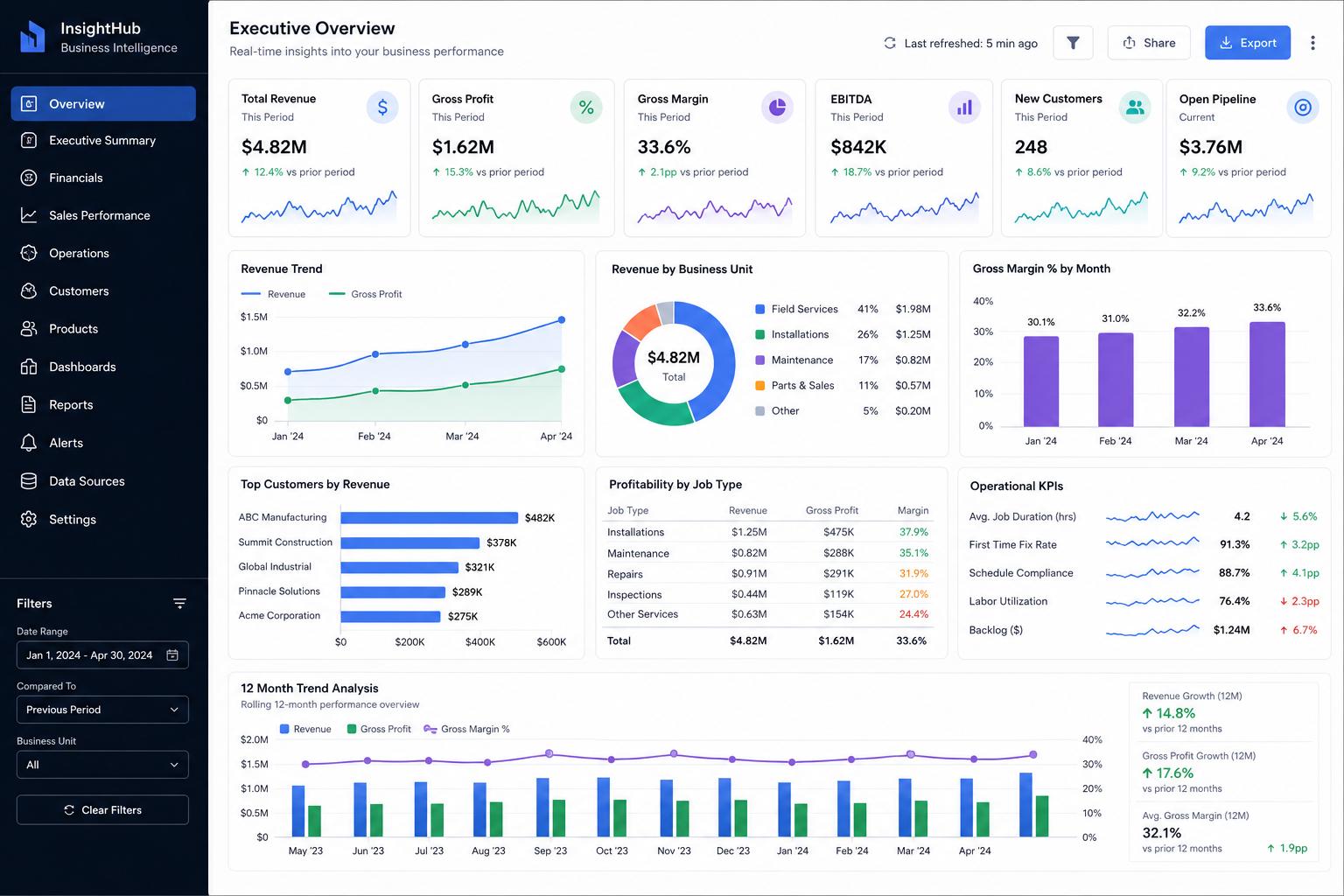
Business Intelligence Dashboards
Executives and managers gain access to real-time insights, KPIs, forecasting, and performance reporting.
Intelligence Solutions
Common Business Intelligence Systems
Profitability Analysis
Track gross margins, job profitability, departmental performance, and operational costs over time.
Sales Performance Intelligence
Analyze lead sources, conversion rates, pipeline velocity, and sales trends across teams.
Operational Trend Analysis
Identify recurring bottlenecks, inefficiencies, workload patterns, and performance gaps.
Seasonal Forecasting
Use historical business data to identify seasonal demand fluctuations and capacity requirements.
Customer Intelligence
Measure retention, customer value, purchasing behavior, and service performance trends.
Executive Reporting Systems
Provide leadership teams with consolidated business metrics and actionable operational insights.
Impact
Typical Operational Improvements
Better Decision Making
Replace assumptions with measurable business data and operational intelligence.
Earlier Problem Detection
Identify declining performance, margin erosion, and operational issues before they become major problems.
Improved Forecasting
Use historical trends to improve planning, budgeting, staffing, and resource allocation.
Greater Visibility
Understand how sales, operations, labor, and financial performance interact across the business.
Reduced Reporting Effort
Eliminate manual spreadsheet consolidation and repetitive report preparation.
Continuous Performance Monitoring
Track key metrics automatically without waiting for month-end reporting cycles.
Compatibility
Built To Consolidate Business Data
Business intelligence systems rely on information from across the organization.
Financial data, operational metrics, sales activity, customer information, and historical records can be consolidated into a single reporting environment.
This allows businesses to analyze performance holistically rather than reviewing isolated reports from individual systems.
FAQ
Frequently Asked Questions
Q: Can business intelligence systems connect to our existing software?
Q: Can we track custom KPIs?
Q: Can historical data be included?
Q: Can managers receive alerts when metrics change?
Q: Is this different from a standard dashboard?
Related Services
Connected Infrastructure
Making Decisions Without Reliable Business Data?
Historical trends, profitability metrics, operational performance, and growth opportunities become much easier to understand when your business data is consolidated and analyzed automatically.